
Detachment 520Cornell University
About Detachment 520
History of ROTC at Cornell
A concise timeline of Cornell ROTC milestones, from the start of military instruction in 1868 to the founding of Detachment 520.
Supported milestones
Detachment 520's historical record holds that Cornell graduates have served with distinction in every major conflict since the Spanish-American War. It states that Cornell commissioned more officers in World War I, and inducted more officers and service members in World War II, than any other single institution, and that a group of Cornell volunteers became the first U.S. unit in combat under fire in the First World War.
1868
Military instruction at Cornell
Cornell traces the beginning of military instruction at the university to 1868.
1914–1917
Barton Hall built
Cornell records that Barton Hall was constructed as an armory and drill hall and was renamed in 1940 for Colonel Frank A. Barton, Class of 1891 — recorded by the Detachment as the first Cornellian granted a commission, and twice Cornell's Professor of Military Science and Tactics.
1917
Formal ROTC unit
Cornell records the establishment of a formal Reserve Officer Training Corps unit in 1917.
1950
Detachment 520
The Air Sciences and Tactics Division, founded under Army ROTC in 1947 alongside the establishment of a separate United States Air Force, formally transitioned into Air Force ROTC Detachment 520 in 1950 under the command of Air Force Colonel George T. Crowell.
From the archive
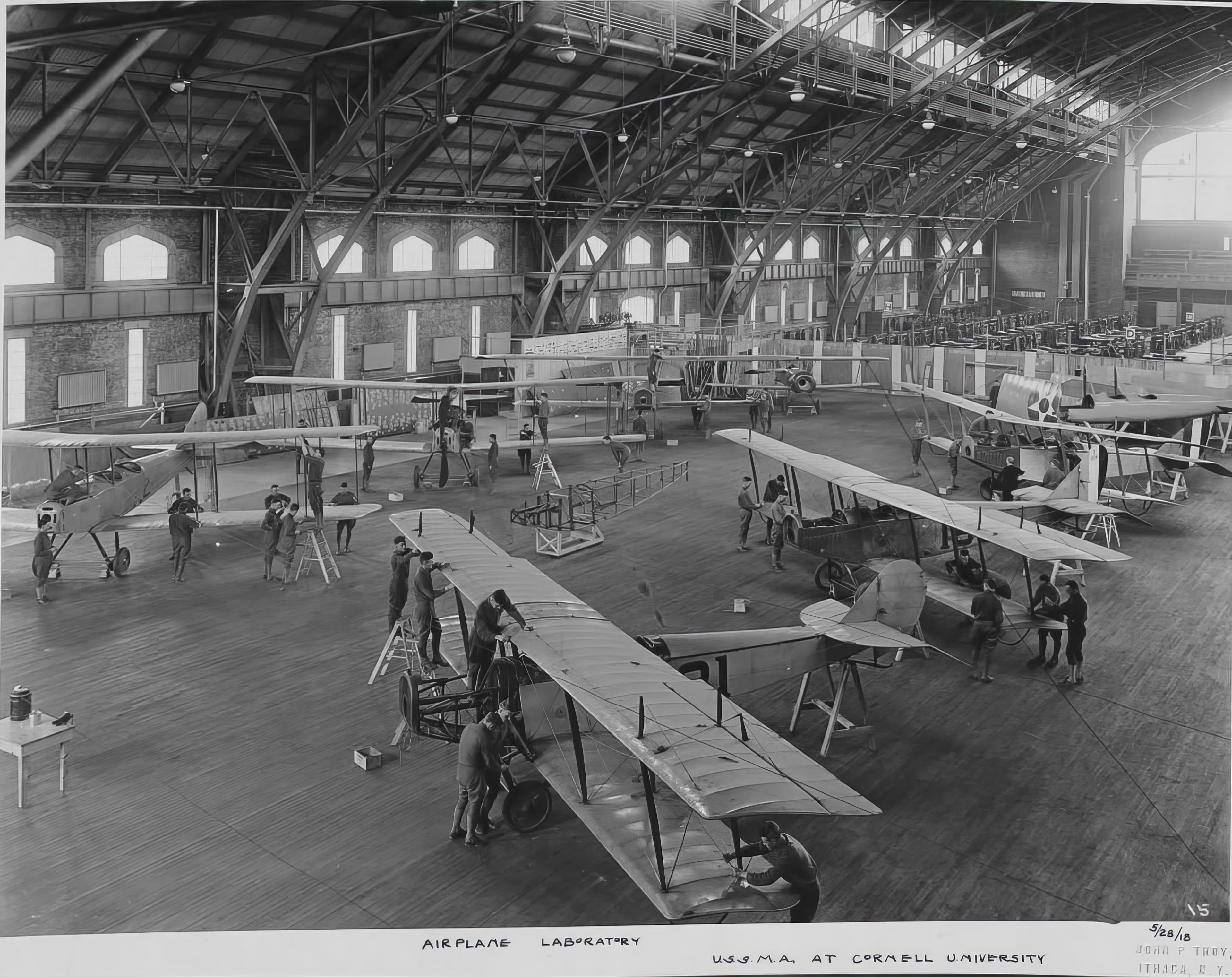
Barton Hall in 1918
Project-owner-supplied period images show the building's early military-aviation era, when the U.S. School of Military Aeronautics trained at Cornell. The prints are captioned and dated on their faces; the airplane laboratory photograph is dated May 28, 1918 and credited to John P. Troy of Ithaca.
Barton Hall and Cornell's military community today
Barton Hall currently houses Cornell's Army, Naval, and Air Force ROTC programs, including Detachment 520. Cornell's military-community and veterans-memorial resources provide broader public context beyond this concise timeline.
