Detachment 520Cornell University
Det 520 · Scholarships & Careers
Benefits & Service Commitments
Air Force ROTC publishes when a service commitment begins on each path into the program and the standard active-duty commitments that follow commissioning. This page summarizes that current national guidance; the terms that apply to any individual are set only through the official contracting process.

Confirm before you decide
The standards below are the published national guidance, current as of their source dates. Nothing on this page establishes what any individual would owe — that is set only by the contract they sign.
When the commitment begins
Joining Air Force ROTC is not enlisting. Cadets are not in the military while in college, and Air Force ROTC's national guidance describes a defined point on each path where a student first takes on a service commitment. Until that point, a student can leave the program owing nothing.
Four-year high-school scholarship
No obligation in the first year
Air Force ROTC states that a student on a four-year high-school scholarship has the first year of college paid and can leave at the end of freshman year with no obligation.
In-college scholarship
Begins when the scholarship is activated
A student offered a scholarship while already in college is not committed until they accept and activate it — usually in the fall of sophomore year.
Without a scholarship
Begins with the junior-year contract
Non-scholarship cadets carry no commitment through the two-year General Military Course. The obligation begins when they sign the Professional Officer Course contract at the start of junior year, committing to active duty after graduation.
At every point
Commissioning follows graduation
Fulfilling the program means committing, at the applicable point above, to serve as an officer after graduating. Service itself begins with commissioning, not while in school.
Detachment 520's own overview describes the same ladder by class year: no obligation as an AS100 even on scholarship, an AS200 obligation only on scholarship, the AS300 service contract, and AS400s continuing under it.
Read the official AFROTC admissions FAQHow long the commitment runs
Air Force ROTC publishes standard active-duty service commitments by career direction. Career fields are assigned later through official selection processes, so which of these applies is not known at contracting.
Most career fields
Four years
Most officers have a four-year active-duty service commitment after commissioning.
Pilots
Ten years
Officers selected as pilots incur a ten-year commitment beginning upon completion of pilot training.
Combat Systems Officers · Air Battle Managers
Six years
Officers selected as Combat Systems Officers or Air Battle Managers incur a six-year commitment after completing their training.
For rated careers the clock starts after training, not at commissioning, so total time in uniform is longer than the commitment alone.
Read the official AFROTC careers FAQQuestions to verify
Take these to an authorized representative rather than trying to answer them from any website, including this one.
Which current opportunity or program status applies to your circumstances?
What are the exact terms of the contract you would sign, as written today?
How would your intended career direction change the commitment you take on?
Which official source controls the decision you are considering?
When a decision is made
Commitment is a considered, official step
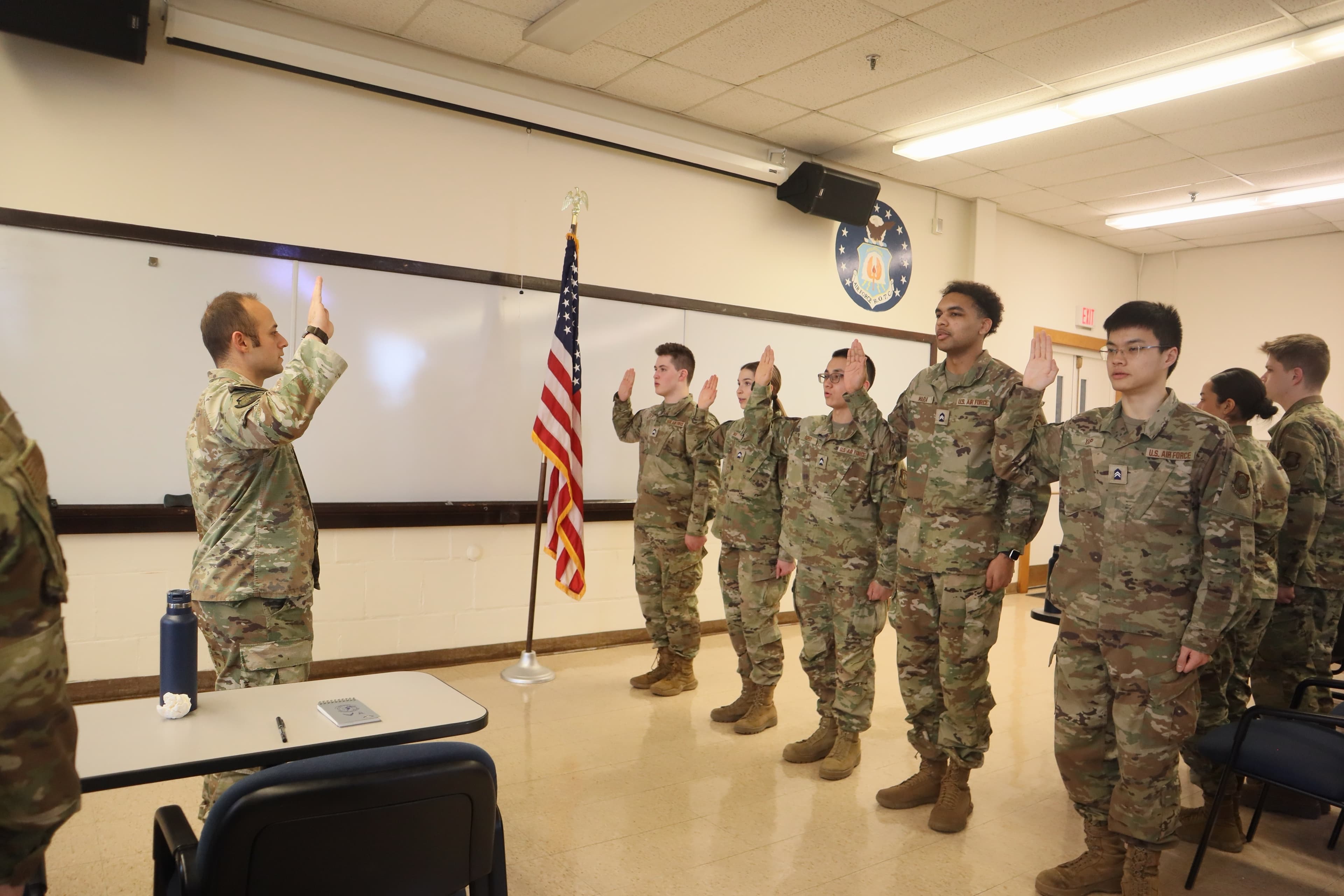
When a student and the Air Force reach a formal decision point, it happens through an official, documented process administered by authorized personnel — never through this website.
Continue exploring
Related information
Scholarships & Financial Benefits
Use the official scholarship source for current cycle information.
Review scholarship informationCareer Pathways
Explore the two services without assuming a career or assignment outcome.
Explore career pathwaysContact Detachment 520
Take individual contracting and commitment questions to an authorized representative.
View contact information